The FLOW Lab (Fluxes in Low Oxygen Waters) is a research group at the Department of Marine Sciences, University of Gothenburg (Sweden).
Oxygen minimum zones are vast layers in the ocean with little to no oxygen and vital implications for marine habitats, carbon and nitrogen cycling, and greenhouse gas production. Over the last 50 years, global oceans have been warming and deoxygenating, yet leading climate models are unable to reproduce observed changes in oxygen minimum zones and forecasts vary drastically under all future climate scenarios. The main obstacle is that models cannot resolve features smaller than their computational grid cells and use simplified biogeochemistry and biology.
We want to understand the role of different ocean processes, from large to small scales, in tipping the balance back and forth between oxygen supply and oxygen consumption across the world’s oceans.
Keywords: ventilation, remineralisation, carbon export, eddies, submesoscale processes, autonomous platforms, Arabian Sea, Baltic Sea, oxygen minimum zones.
Contact details: bastien.queste@marine.gu.se
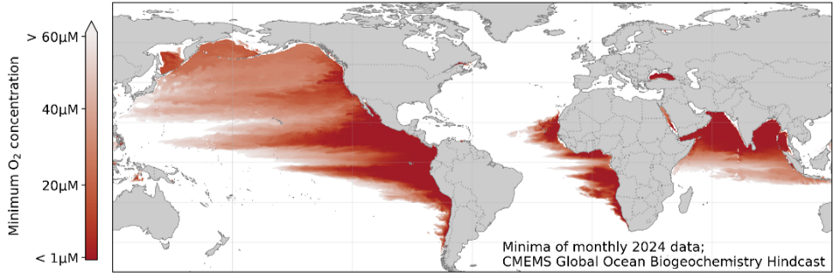
Oxygen minimum zones (above, in red) are parts of the ocean where the water contains very little dissolved oxygen. They usually sit below the sunlit surface, where dead algae and other organic matter sink and are broken down by microbes. That breakdown uses up oxygen, while the supply of fresh oxygen from the surface or from currents is often weak because the warm surface waters struggle to mix with deeper colder waters.
These low-oxygen regions matter because they are not just “dead zones” (a deeply problematic and incorrect term!). They shape where animals can live, how nutrients are recycled, how much carbon the ocean can store, and whether microbes produce climate-relevant gases such as nitrous oxide. Small changes in oxygen can therefore have large effects on ecosystems and on the ocean’s role in the climate system.
A growing body of work suggests that big thhings happen at surprisingly small scales: swirling eddies, thin intrusions, internal waves, dense water spilling from marginal seas, and even salt-driven mixing known as salt fingers, can either inject oxygen into oxygen-starved waters or deliver organic carbon that later consumes oxygen as it decays. These ocean processes are often too small, too fast, or too patchy to be captured by ships or coarse climate models that we have traditionally relied on.
Autonomous ocean gliders (remote controlled submarines the size of a person) are especially powerful because they can repeatedly dive through the water column for weeks to months, measuring oxygen, temperature, salinity, currents, chlorophyll, and particles at very high resolution. In effect, they reveal the hidden pathways of carbon and oxygen in oxygen minimum zones. By watching how oxygen-rich water and carbon-rich particles move through these layers, gliders help explain why oxygen minimum zones grow, shrink, ventilate, or intensify - and why getting the small scales right may be essential for predicting the ocean’s future.
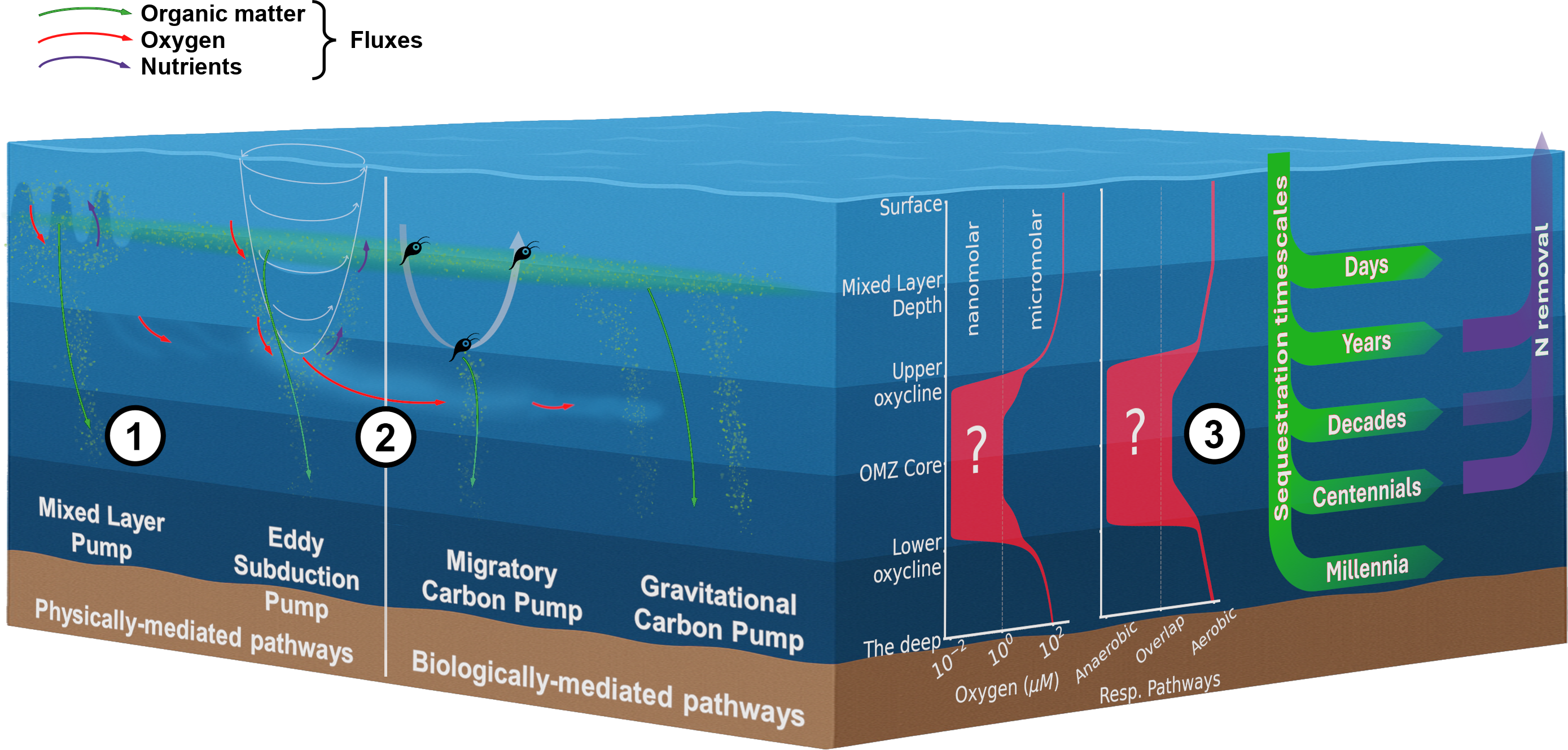
(above left) Particulate and dissolved organic matter is exported (1: green arrows) by physical and biological export pumps to the OMZ providing fuel for respiration. Physical carbon pumps also cause simultaneous nutrient and O2 fluxes (left, 1 & 2, red and purple arrows). These fine-scale O2 fluxes contribute to variability locally, and remotely when advected (2), affecting which respiration pathways are expressed (3: right) with global climate impacts via carbon sequestration and nitrogen removal.